본문 바로가기 대메뉴 바로가기

한밭대학교

HIGHHANBAT

Edu & Research

게시물 검색
Hanbat National University Professor Lee Jang-won Research Team Develops Technology to Control Light Momentum in the Nano World 이미지
Hanbat National University Professor Lee Jang-won Research Team Develops Technology to Control Light Momentum in the Nano World
  • 작성자기획과
  • 조회수48
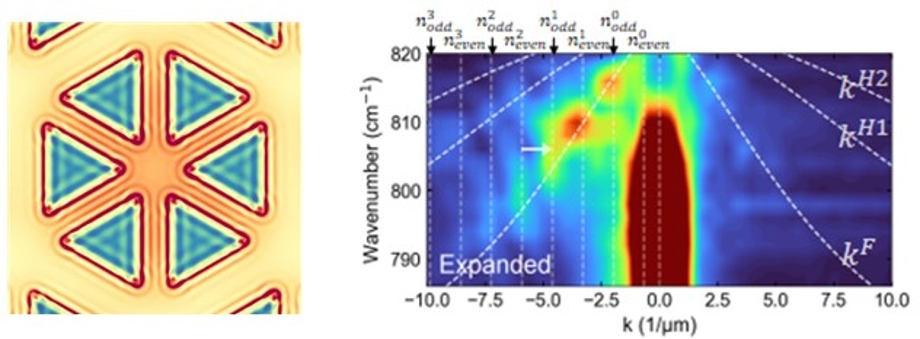
  • Photo description: Spatial distribution (left) and momentum distribution (right) of quantized light inside the photonic crystal cavity.The momentum of the wave formed by the combination of light and matter through the photonic crystal cavity is structurally designed and selectively controlled.- Conducted joint research with researchers from the Korea Research Institute of Standards and Science, published in Science Advances- Fabricated a new nano-optical cavity that quantizes the momentum of the coupled state of light and vibration□ Hanbat National University (President Oh Yong-joon) Professor Lee Jang-wons research team and the Korea Research Institute of Standards and Science joint research team overcame the optical limitations of two-dimensional semiconductor materials, fabricated a new nano-optical cavity (resonator) that quantizes the momentum of phonon polaritons, and published their research results on the 28th in the international journal Science Advances (IF 13.9, top 8% of JCR).[ Realization of Momentum Quantization of Hyperbolic Phonon Polaritons Using Photonic-Crystal Cavity ]□ Hyperbolic Phonon Polaritons existing inside hexagonal boron nitride (h-BN) have attracted attention as a core platform for next-generation mid-infrared nanophotonics because they have different dispersion characteristics depending on the direction.○ However, conventionally, losses occurred due to continuous dispersion relations or it was technologically tricky to realize high-quality (High-Q) resonance states.○ To solve this problem, the research team devised a Hyperbolic Polaritonic Cavity Crystal (HPCC) combining a boron nitride thin film with a Photonic-Crystal nanocavity structure.○ By inducing Fabry-Prot phase-matching conditions through periodic lateral boundaries, they succeeded in converting the continuous dispersion relation into a quantized state of discrete momentum eigenstate.[ Real-space Visualization and Ultra-high Efficiency Performance Demonstration via Cutting-edge Optical Microscope ]□ The research team designed and fabricated a photonic crystal through nano-processing and precisely measured the strongly confined electromagnetic field strength inside using Photo-induced Force Microscopy (PiFM).○ Through this, they succeeded in directly measuring the quantized modes trapped inside the nanostructure in momentum and real space.○ They demonstrated that the cavity structure simultaneously achieves a high quality factor (Q-factor) and ultra-small mode volume, leading to a high Purcell effect, which is expected to be widely utilized in the future for high-sensitivity spectroscopic analysis, selective vibrational spectroscopy, and the development of reconfigurable mid-infrared nano-optical devices.□ Meanwhile, this research was published on the 28th in the journal Science Advances under the title Momentum quantization of hyperbolic phonon polaritons in photonic-crystal cavity.○ Furthermore, this research was jointly conducted by the research team of Professor Lee Jang-won at Hanbat National University and the research team of Drs. Chang Jeong-hun and Lee Eun-sung at the Korea Research Institute of Standards and Science, and was carried out with the support of the Ministry of Science and ICTs Individual Basic Research Excellent Research Program and the Korea Research Institute of Standards and Science's Strategic Research Program for Establishing Quantum Material Performance Evaluation Platforms.
  • 등록일2026-10-30 11:03:59
Hanbat National University Sees 11 Researchers Named to the '2026 World's Top 2% Scientists' 이미지
Hanbat National University Sees 11 Researchers Named to the '2026 World's Top 2% Scientists'
  • 작성자기획과
  • 조회수44
  • - 9 selected in Career-long category, 7 selected in Single-year category- 5 researchers including Cho Jin-gyun, Park Kyung-tae, Kim Ki-chan, Yu Seon-yul, and Sudipta Chatterjee selected in both categories□ Hanbat National University (President Oh Yong-joon) announced on the 13th that a total of 11 researchers from the university were selected for the '2026 World's Top 2% Scientists list recently announced by Elsevier, a global publishing company in science, medicine, and technology, and a research team led by Professor John P.A. Ioannidis of Stanford University.○ The World's Top 2% Scientists list announced this year is based on the database up to 2025, selecting researchers worldwide who have published at least 5 papers across 22 scientific fields and 174 sub-fields by analyzing their influence based on citation impact calculated using the SCOPUS database.□ The Worlds Top 2% Scientists list is announced in two categories: Career-long and Single year. Hanbat National University had 9 researchers named in the Career-long category, 7 in the Single-year category, and 5 individuals appearing in both categories.○ First, in the Career-long category, a total of 9 researchers were selected: △Professor Cho Jin-gyun (Department of Building Systems Engineering), △Professor Emeritus Park Kyung-tae (Department of Materials Science and Engineering), △Professor Emeritus Kim Kwang-ju, Professor Hong Seong-wook, and Professor Yu Seon-yul (Department of Chemical and Biological Engineering), △Professor Kim Ki-chan and Professor Kwon Jung-min (Department of Electrical Engineering), △Professor Choi Byung-ho (Department of Civil and Environmental Engineering), and △Researcher Sudipta Chatterjee (Department of Chemical and Biological Engineering).○ In addition, the Single-year category, which reflects research impact for the year 2025, included a total of 7 researchers: △Professor Cho Jin-gyun (Department of Building Systems Engineering), △Professor Park Kyung-tae and Professor Kim Jeong-han (Department of Materials Science and Engineering), △Professor Yu Seon-yul (Department of Chemical and Biological Engineering), △Professor Kim Ki-chan (Department of Electrical Engineering), △Professor Yu Seong-jin (Department of Mobile Convergence Engineering), and △Researcher Sudipta Chatterjee (Department of Chemical and Biological Engineering).○ Among them, a total of 5 researchers△Professor Cho Jin-gyun (Department of Building Systems Engineering), △Professor Park Kyung-tae (Department of Materials Science and Engineering), △Professor Yu Seon-yul (Department of Chemical and Biological Engineering), △Professor Kim Ki-chan (Department of Electrical Engineering), and △Researcher Sudipta Chatterjee (Department of Chemical and Biological Engineering)were named to both the Career-long and Single year categories.□ Hanbat National University President Oh Yong-joon stated, The fact that our universitys researchers are consistently selected for the Worlds Top 2% Scientists announced every year proves that Hanbat National Universitys research capabilities possess globally competitive excellence, adding, We will continue to support our professors and researchers so that they can exercise greater influence in more fields through creative research activities.
  • 등록일2026-10-13 10:56:45
Department of Mechanical Engineering Research Team Selected for 2026 Ministry of Education 'Glocal Lab' Program 이미지
Department of Mechanical Engineering Research Team Selected for 2026 Ministry of Education 'Glocal Lab' Program
  • 작성자기획과
  • 조회수230
  • - Hanbat National University Production Convergence Technology Research Institute leads securing future source technologies as a hub specialized in 'eco-friendly mobility materials and components□ Hanbat National University (President Oh Yong-jun) announced that the Department of Mechanical Engineering research team has been finally selected for the 'Glocal Lab (Consortium Type)' (headed by Professor Yoon Hong-seok of the Department of Mechanical Engineering), a 2026 academic research support project in the science and engineering field supervised by the Ministry of Education and the National Research Foundation of Korea.□ This Glocal Lab consortium type is a large-scale national research support project that establishes global research hubs connecting the region and the world through convergence among excellent affiliated research institutes within universities, and intensively fosters succeeding generations of scholars.○ The consortium forms a convergence body of excellent research institutes from three hub universities, including Hanbat National University (specialized in materials and components), the leading university Kongju National University (specialized in production and design), and KAIST (specialized in intelligence and control), and will promote research and development and talent fostering projects totaling KRW 21.6 billion (KRW 5.4 billion for Hanbat National University) over the next 9 years.□ In this project, Hanbat National University will lead the 'development of convergent core technologies to maximize driving range of eco-friendly mobility through fostering advanced talent', centered around the on-campus 'Production Convergence Technology Research Institute' (Director Professor Yoon Hong-seok).○ In particular, Hanbat National University will focus on developing 'material and component source technologies' that determine mobility energy efficiency and durability, exclusively undertaking key tasks such as ▲ next-generation high-efficiency electrode materials, ▲ high-heat-dissipation and high-thermal-insulation composite battery materials for thermal runaway prevention and weight reduction, and ▲ development of optomechanical components for responding to extreme environments such as bad weather.○ A robust research team has been established with a large participation of nine full-time faculty members from the Department of Mechanical Engineering, including Director Professor Yoon Hong-seok, Professor Kim Young-sik, Professor Kim Ji-seok, Professor Noh Jin-seong, Professor Park Sung-yeon, Professor Shin Bu-hyeon, Professor Lee Ho-chul, Professor Jeong Gil-eon, and Professor Ha Ji-hwan.□ Professor Yoon Hong-seok stated, "Maximizing driving range ultimately begins with materials and components, and Hanbat National University has taken on the first stage of the full-cycle value chain where high-efficiency materials and components developed by Hanbat National University are completed into actual vehicles through Kongju National University's production technology and KAIST's intelligent control," adding, "We will grow it into a hub research institute that supplies source technologies within the region necessary for materials, parts, and equipment companies in the Daejeon and Chungcheong region to transition into eco-friendly mobility component companies."○ In addition, Hanbat National University plans to operate full-cycle scholarship support and industry-academia joint projects to foster early-career researchers as independent researchers for cultivating talent tailored to regional strategic industries, thereby creating a virtuous cycle ecosystem where advanced master's and doctoral-level research personnel produced through this can settle in regional companies and research institutes.
  • 등록일2026-09-30 10:56:25
Hanbat National University Selected for MSIT's 'AI Top-tier Young Researcher Support Program', Total Scale of 11.5 Billion KRW  이미지
Hanbat National University Selected for MSIT's 'AI Top-tier Young Researcher Support Program', Total Scale of 11.5 Billion KRW
  • 작성자기획과
  • 조회수219
  • - Developing AI source technologies responding to the full lifecycle of veterinary biological systems through interdisciplinary joint research with Chungbuk National University- Fostering top tier young AI convergence researchers based on Sejong Joint Campus□ Hanbat National University (President Oh Yong-jun) announced on the 4th that it has been finally selected for the interdisciplinary linked track of the '2026 AI Top-tier Young Researcher Support Program' supervised by the Ministry of Science and ICT and the Institute for InformationAI based virtual biomodeling and simulation technology,multimodal AI based decision support technology, andAIoT based biological and behavioral monitoring and prediction technology. They plan to sequentially develop veterinary specialized virtual cell models, veterinary clinical multimodal AI and clinical reasoning agents, and companion and wild animal biological and behavioral monitoring technologies.○ In addition, this project is operated as a young researcher centered joint research system, supporting participating young researchers to lead joint research projects, accumulate interdisciplinary research experience and research leadership, and grow into top tier young researchers equipped with both AI core technology development capabilities and veterinary domain problem solving capabilities.○ Professor Jeon Yun-ho of the Department of Artificial Intelligence Software at Hanbat National University, the principal investigator, stated, "The core of this project is to develop complex problems in veterinary clinical fields into new AI source technology research and to substantially combine the strengths of both universities based on the Sejong Joint Campus," adding, "We will strive to produce world class AI convergence research outcomes and foster young researchers equipped with independent research capabilities."□ Hanbat National University plans to expand AI convergence research to fields such as digital biohealth, companion animal precision medicine, infectious and intractable diseases, preventive veterinary medicine, and wildlife conservation based on the research outcomes and cooperation system established through this project.
  • 등록일2026-09-04 10:55:17
Creative Convergence Undergraduate Student Cho Yoon-seo Publishes First Author Paper in Prestigious IEEE International Journal 이미지
Creative Convergence Undergraduate Student Cho Yoon-seo Publishes First Author Paper in Prestigious IEEE International Journal
  • 작성자기획과
  • 조회수333
  • - Developing safety operation control technology for autonomous driving hydrogen fuel cell energy systems- A remarkable achievement where an undergraduate student led research as first author in a prestigious IEEE international journal□ Hanbat National University (President Oh Yong-jun) announced that a paper in which 4th year student Cho Yoon-seo of the Department of Creative Convergence participated as first author was published in 'IEEE Journal of Emerging and Selected Topics in Industrial Electronics (JESTIE), a prestigious international journal of theIEEE (Institute of Electrical and Electronics Engineers).○ JESTIE is an IEEE international academic journal covering the latest technologies and convergence research in industrial electronics, ranking within the top 30% with an Impact Factor of 4.9 and placed in approximately the top 26% of the electrical and electronic engineering category based on recently released JCR indicators.□ This paper, titled 'A Hierarchical State Based Control Architecture for Safe Operation of PEMFC Energy Systems in Autonomous Agricultural Robots', proposed control technology for stable operation and rapid fault response of hydrogen fuel cell systems applied to unmanned vehicles.○ Student Cho Yoon-seo structurally separated the normal operation xss-layer and the protection xss-layer, and designed a hierarchical architecture that controls the system based on 6 operating states: standby, preparation, normal operation, stop, fault, and emergency shutdown.○ In particular, stack temperature, current, hydrogen supply pressure, and hydrogen concentration are monitored in parallel across all operating states, configured so that fault protection and emergency shutdown operations take priority over normal operation if abnormal conditions occur.○ The research team implemented the proposed control technology in a microcontroller unit (MCU) based controller with limited computing and memory resources, and experimentally verified it using a 1 kW open cathode polymer electrolyte membrane fuel cell (PEMFC) stack.○ In tests gradually increasing the load up to 16 A, steady state transitions were performed stably, and functions such as 100 ms SCU operation, transient fault signal removal, persistent fault detection, and recovery after checking safety conditions were repeatedly confirmed.□ This achievement holds great significance in that student Cho Yoon-seo led the overall research during undergraduate studiesfrom control architecture design to xss-embedded system implementation, fuel cell stack experimentation, and result analysisand developed it into a first author paper in an IEEE international journal ranked in the top 30% of JCR.○ It is a rare case for an undergraduate student to serve as first author in research conducted with professional researchers and publish a paper in an influential IEEE international journal, demonstrating student Cho Yoon-seo's outstanding research capability and growth potential.○ In particular, this study is the result of student Cho Yoon-seo directly participating in the Korea Institute of Machinery and Materials' hydrogen fuel cell based autonomous robot development project, designing an energy system control architecture based on operational and safety requirements derived from actual development sites, and verifying performance through hardware implementation and fuel cell stack testing.○ This is evaluated as a case that secured both the practicality of research achievements and applicability to industrial sites by defining problems of actual systems and implementing solutions beyond mere theoretical research.□ Student Cho Yoon-seo said, "It is very meaningful that the research conducted during undergraduate studies led to publication in an IEEE international journal, and I want to continue researching practical technologies that can be applied to industrial fields in the future.□ Advising Professor Park Jeong-eon of the Department of Creative Convergence said, "Student Cho Yoon-seo analyzed system problems independently and faithfully carried out the entire research process from control algorithm design to hardware implementation and experimental verification," adding, "In particular, when faced with unexpected technical problems, the student demonstrated outstanding concentration and problem solving capability in structurally analyzing causes, establishing hypotheses independently, and verifying them repeatedly.○ He added, "Based on this achievement, I expect the student will grow into an outstanding researcher in fuel cell energy systems and autonomous mobile vehicle control fields.□ Meanwhile, this paper was published online on the 12th in the IEEE international journal(https://ieeexplore.ieee.org/document/11652894)
  • 등록일2026-08-19 17:40:37
Professor Lee Jae-hyun of the Department of Creative Convergence Proposes New Interface Design Strategy to Simultaneously Improve OLED Efficiency and Lifespan 이미지
Professor Lee Jae-hyun of the Department of Creative Convergence Proposes New Interface Design Strategy to Simultaneously Improve OLED Efficiency and Lifespan
  • 작성자기획과
  • 조회수317
  • - Improved reliability of OLED displays expected to drive widespread adoption not only in small smart devices but also in equipment such as monitors□ Hanbat National University (President Oh Yong-jun) announced that a joint research paper in which Professor Lee Jae-hyun of the Department of Creative Convergence participated as corresponding author was published online in 'Chemical Engineering Journal' (Impact Factor 12.5), an internationally renowned academic journal published by Elsevier, a global science and technology publisher.○ Titled "Negative giant surface potential engineering for suppressing exciton polaron quenching in organic light emitting diodes", this paper had Hanbat National University's Park Jae-yong, Samsung Electronics SAIT's Lee Yeon-gyeong, and Hanbat National University Key Research Institute Project Group researcher Choi Young-wook participate as joint first authors, while Dr. Kim Jong-soo of Samsung Electronics SAIT and Professor Lee Jae-hyun of Hanbat National University participated as joint corresponding authors.□ Through this study, the research team identified the key cause that simultaneously reduces OLED efficiency and lifespan, and proposed a new interface design strategy to control it.○ Giant Surface Potential (GSP) is formed due to Spontaneous Orientation Polarization (SOP) inside OLEDs, which causes excessive holes to accumulate around the emitting xss-layer, resulting in exciton polaron quenching (EPQ).○ Such EPQ is known to be a major cause of reducing the luminous efficiency and long term reliability of OLEDs.○ The research team proposed a new OLED design strategy to precisely control interface charges by introducing an Electron Blocking xss-layer (EBL) with a negative (-) GSP.○ In addition, through diverse electrical and optical analyses, the team systematically identified the mechanism of interface charge accumulation and EPQ occurrence, confirming that while an EBL with an appropriate magnitude of negative GSP suppresses unnecessary hole accumulation to reduce EPQ and improve efficiency and operational stability, an EBL with an excessively large negative GSP excessively suppresses hole injection instead, which can degrade OLED performance.○ Through this, the team presented optimal GSP design criteria for improving OLED performance; in particular, OLEDs applying the optimal negative GSP proposed by the research team showed an improvement in operational lifetime (LT95) of about 119.5% compared to the reference device, demonstrating the achievement of simultaneously improving efficiency and operational lifespan.○ The results of this study are expected to be utilized not only for OLEDs but also for interface design technologies of diverse optoelectronic devices based on organic semiconductors.□ Professor Lee Jae-hyun stated, "This study experimentally identified that exciton polaron quenching, the fundamental cause of optical energy loss, can be effectively suppressed by precisely controlling interface charge behavior inside OLEDs," adding, "We expect it will be utilized as a new design strategy to enhance the efficiency and reliability of diverse organic optoelectronic devices going forward."□ Meanwhile, this study was conducted as a joint research project with Samsung Electronics SAIT, and was supported by the [Ministry of Education and National Research Foundation of Korea / Key Research Institute Support Project (2018R1A6A1A03026005); Active Printed Electronics Systems Using Hybrid 3D Printing] and the [Ministry of Science and ICT and National Research Foundation of Korea Basic Research Project (RS-2024-00359103); Identification of Electron Spin Behavior and Applications Through Development of Electroluminescent Magnetic Resonance Devices].
  • 등록일2026-08-11 17:37:51
Hanbat National University Receives 'Grade A' in the First-Year Evaluation of Daejeon RISE Project 이미지
Hanbat National University Receives 'Grade A' in the First-Year Evaluation of Daejeon RISE Project
  • 작성자기획과
  • 조회수374
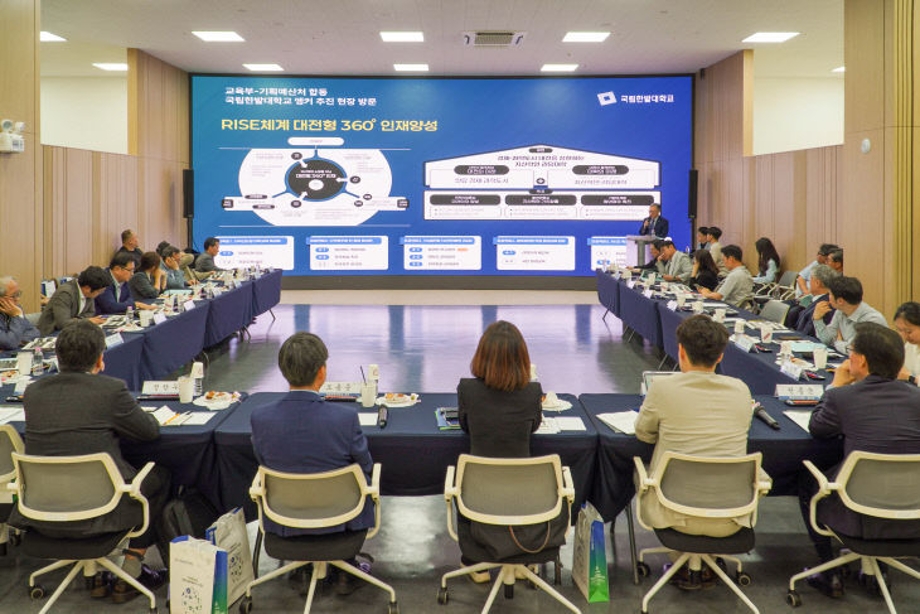
  • - Organically linking university long term development plan with Daejeon City ANCHOR project goals- Recognizing industry academic cooperation results including opening of joint AI semiconductor microdegree and 36.6% increase in joint research papers with national research institutes□ Hanbat National University (President Oh Yong-jun) ANCHOR (formerly RISE) Project Group announced on the 23rd that it achieved 'Grade A' in the first-year performance evaluation of the Daejeon Metropolitan City RISE project.○ Hanbat National University received high marks for organically linking its long term development plan, 'Regional Industry University Research Integrated Innovation Platform University', with the goals of the Daejeon ANCHOR (formerly RISE) project, and for promoting the project based on a systematic analysis of regional strategic industries and the youth employment environment.○ In particular, the university was positively recognized for successfully building an education and research foundation for the transition to the ANCHOR system, including the College of AI Convergence, advanced departments, and the Convergence Research Institute.□ Looking at the results of detailed unit tasks, in the field of nurturing future talent, a joint AI semiconductor microdegree course with 4 broad regional universities was newly established to lay the foundation for training talent in strategic industries.○ Also, through the phased operation of field training and Capstone Design, the university achieved a 53% rate of company connected Capstone Design and newly introduced Capstone Design linked with national research institutes.○ In the field of research cooperation with national research institutes, the university introduced and operated an 'Analyst System' to analyze ties between strategic industries and national research institutes, leading to a 36.6% increase in joint research papers compared to the three-year average before the RISE project.○ Finally, in the field of industrial workforce retraining, the Hanbat Employee Education Center 'H AWTA' was established, and previously dispersed employee education programs were integrated and operated, producing a total of 944 graduates.○ In addition, in the fields of intercollegiate educational cooperation, regional startups, and solving local issues, a cooperative system where universities, national research institutes, companies, and local communities participate together was established.○ Starting from the second year, the Hanbat National University ANCHOR Project Group plans to advance the project centering on student growth and broad regional cooperation by introducing an AI powered student growth tracking system and establishing a Space and Defense Research Center and an ANCHOR Equipment Support Center.□ Hanbat National University ANCHOR Project Group Head Woo Seung-han said, "This acquisition of Grade A is a result achieved through cooperation among the university, national research institutes, companies, and the local community." He added, "Based on the industry academic cooperation capabilities accumulated by Hanbat National University, we will work harder to expand real results leading to student growth and regional settlement."
  • 등록일2026-07-23 13:14:26
Professor Hong Ki-ha's Research Team in the Department of Materials Science and Engineering Selected for 2026 Basic Research Laboratory (BRL) Support Project 이미지
Professor Hong Ki-ha's Research Team in the Department of Materials Science and Engineering Selected for 2026 Basic Research Laboratory (BRL) Support Project
  • 작성자기획과
  • 조회수383
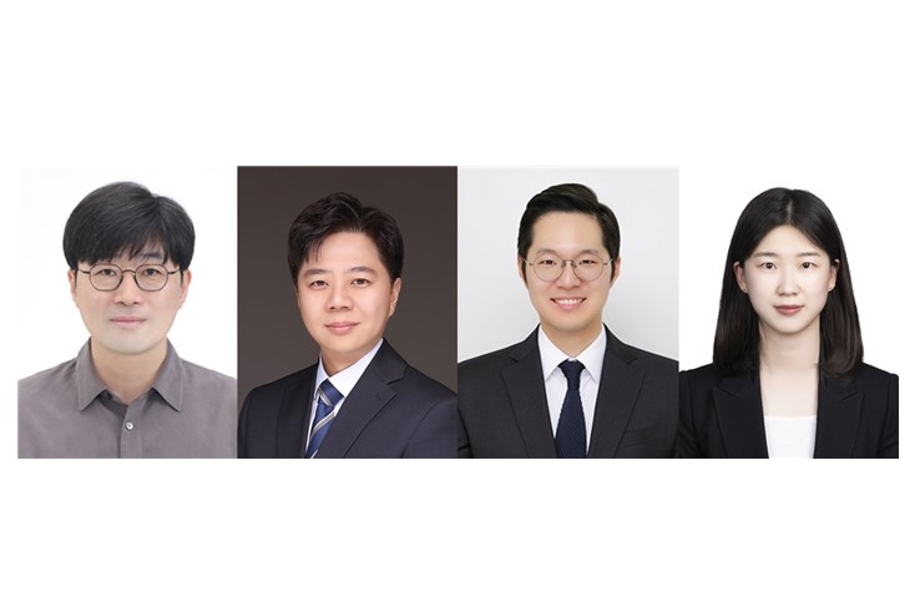
  • Photo Description: Hanbat National University research team participating in the '2026 Basic Research Laboratory Support Project' (From left, Hanbat National University Department of Materials Science and Engineering Professors Hong Ki-ha, Kim Jeong-hwan, Koo Kyo-jin, and Department of Chemical and Biological Engineering Professor Park Je-hee)- Conducting research on the development of cathode materials for next generation sodium secondary batteries combining AI and new processes□ Hanbat National University begins research on the development of cathode materials for next generation sodium secondary batteries combining AI and new processes.□ Hanbat National University (President Oh Yong-jun) announced that the research team of Professor Hong Ki-ha from the Department of Materials Science and Engineering was finally selected for the '2026 Basic Research Laboratory (BRL) Support Project' organized by the Ministry of Science and ICT and the National Research Foundation of Korea, receiving a total of 1.5 billion won in research funds for 3 years from July 2026 to June 2029.○ The Basic Research Laboratory Support Project is a representative collective research project that supports outstanding researchers in forming research groups to conduct creative and challenging basic research.□ The research team of Professor Hong Ki-ha (Principal Investigator) from the Department of Materials Science and Engineering at Hanbat National University includes Professors Koo Kyo-jin and Kim Jeong-hwan from the same department and Professor Park Je-hee from the Department of Chemical and Biological Engineering, and was selected under the theme of 'Rapid Development Study of Novel High Entropy Na DRX Cathode Materials Based on AI' in this project.○ While currently widely used lithium ion batteries offer excellent performance, price volatility and supply instability of lithium resources have been continuously pointed out as problems, whereas sodium is abundant on Earth and low in cost, attracting attention as a core material for next generation low cost secondary batteries.○ However, there are still many tasks to be resolved for sodium secondary batteries to be commercialized, and in particular, the fact that a standard cathode material satisfying both price and performance like the LFP cathode material of lithium ion batteries has not yet been established is cited as the biggest limitation.□ To solve the problem of the absence of standard cathode materials, which is the core challenge of sodium secondary batteries, Professor Hong Ki-ha's joint research team aimed to pioneer a new material group called high entropy sodium disordered rocksalt (DRX) cathode material.○ This research is conducted through the organic collaboration of 4 specialized research teams covering the entire material development cycle, including material design (Hong Ki-ha), high speed synthesis (Koo Kyo-jin), structural analysis and electrochemistry (Park Je-hee), and ALD interface control (Kim Jeong-hwan), and the development outcomes are expected to expand into electrode material design principles applicable not only to sodium secondary batteries but also across next generation energy storage systems such as lithium and potassium.○ A research team official said, "We will systematically identify new design principles for sodium secondary battery cathode materials and develop them into AI based material development technology to present a new paradigm in the future next generation secondary battery market."
  • 등록일2026-07-03 11:28:16
Professor Kim Min-hoe of the Department of Creative Convergence Engineering Presents Design Criteria for Polymer Tunneling Layers for Organic Memory Devices 이미지
Professor Kim Min-hoe of the Department of Creative Convergence Engineering Presents Design Criteria for Polymer Tunneling Layers for Organic Memory Devices
  • 작성자기획과
  • 조회수326
  • - Demonstrating the potential to improve organic memory performance through polymer structure systematization□ Hanbat National University (President Oh Yong-jun) announced on the 25th that a co-authored research paper in which Professor Kim Min-hoe from the Department of Creative Convergence Engineering participated as a corresponding author was published online in 'Materials Horizons (Impact Factor 11.4) an internationally renowned academic journal published by the Royal Society of Chemistry in the United Kingdom.○ This study was conducted under the paper title of 'Molecule-in-Memory: A Multiscale Guideline for Polymeric Tunnelling xss-layers Linking Molecular Motifs to Electrical Outcomes' and Professor Kim Min-hoe and Professor Yuji Shibasaki a co-researcher from Iwate University in Japan participated as corresponding authors.□ The research team presented design criteria for a polymer tunneling xss-layer that plays a key role in electric field-based charge-storage organic non-volatile memory.○ Organic charge-trap memory is drawing attention as a promising technology for implementing next-generation flexible and low-power electronic devices. However, systematic design guidelines linking the molecular structure of the polymer tunneling xss-layer to actual device performance have been lacking until now.○ Especially, while previous studies have focused on optimizing individual physical properties -such as dielectric constant, charge mobility, trap density and leakage current, this study suggested that the electrical characteristics of the polymer tunneling xss-layer are determined not by a single physical property but by the interrelationships of multiple physical and chemical factors.○ Through this approach, the team analyzed the process by which molecular-level structural motifs lead to macroscopic device performance such as memory window, on/off current ratio and data retention characteristics from a multiscale perspective.□ The research team confirmed that key factors such as Fowler-Nordheim tunneling, dielectric constant, field-effect mobility, trap density, and leakage current can be balanced by applying P(DTDB-DB), a low-dielectric polymer with intrinsic microporous properties, as a tunneling xss-layer.○ The organic charge-trap memory with a P(DTDB-DB) tunneling xss-layer showed improved memory window, on/off current ratio, and data retention characteristics compared to devices using conventional polymer dielectrics as tunneling xss-layers.○ In addition, it implemented multi-bit operation even under low-voltage driving conditions presenting the possibility of developing low-power and high-density organic memory devices in the future.□ Professor Kim Min-hoe said, This study is meaningful in that it systematically explained how the molecular structure and nano-scale physical properties of polymers are linked to the electrical performance of actual memory devices and added An approach that designs the balance of multiple nano-factors rather than simple enhancement of individual physical properties can become an important standard for improving the performance and securing the reliability of organic non-volatile memory.○ He also noted, Organic memory devices can be linked to various application fields such as flexible electronic devices wearable systems and next-generation low-power information storage devices and added We expect that the polymer tunneling xss-layer design strategy presented in this study will contribute to the expansion of future organic electronic devices and polymer-based semiconductor materials research.□ Meanwhile, this study was conducted with support from the Key Research Institutes Support Program of the Ministry of Education-National Research Foundation of Korea and the International Cooperation Program managed by the Ministry of Science and ICT-National Research Foundation of Korea.
  • 등록일2026-06-25 15:06:14
Hanbat National University Professor Kim Jung-hwan’s Team Identifies Principle of Enhancing Oxide Semiconductor Performance through Oxygen Pressure Control 이미지
Hanbat National University Professor Kim Jung-hwan’s Team Identifies Principle of Enhancing Oxide Semiconductor Performance through Oxygen Pressure Control
  • 작성자기획과
  • 조회수327
  • Photo caption: Hanbat National University Department of Applied Materials Engineering Master's student Ha Ji-hoon left and Department of Materials Science and Engineering Professor Kim Jung-hwanFigure caption: Schematic diagram of research on zinc oxide ZnO semiconductor material changes according to oxygen pressure control in rapid thermal annealing by Professor Kim Jung-hwan's research team at Hanbat National University- Reduction of defects and improvement of device characteristics in oxide semiconductors for next-generation displays and 3D memory□ Hanbat National University (President Oh Yong-jun) announced that a research team led by Professor Kim Jung-hwan from the Department of Materials Science and Engineering(first author Ha Ji-hoon in the Master's program) identified that by precisely controlling oxygen pressure during a Rapid Thermal Annealing process defects in oxide semiconductors utilized for next generation displays and 3D memory can be effectively reduced and device performance can be enhanced.○ This study was conducted on zinc oxide ZnO thin-film transistors which are representative oxide semiconductors and it is meaningful in that it presented a practical process optimization plan capable of enhancing the performance of oxide semiconductor devices through only oxygen pressure control in a heat treatment process without introducing new materials or complex additional processes.□ Oxide semiconductors are drawing attention as core materials for future semiconductor technologies such as next-generation displays 3D memory and neuromorphic devices based on their excellent electrical characteristics and possibility for low-temperature processes.○ However, because device performance varies greatly depending on the microstructure and defect state of thin films, precise defect control is essential. Previous studies have mainly focused on changes in heat treatment temperature or atmospheric gas composition leaving it insufficiently revealed that thin-film quality and device characteristics can vary depending on oxygen pressure even in the same oxygen atmosphere.□ Accordingly, Professor Kims research team set oxygen pressure as a core process variable in the rapid thermal annealing process for zinc oxide thin-film transistors fabricated through an Atomic xss-layer Deposition ALD process and analyzed its effects on thin-film characteristics and device performance.○ As a result, it confirmed that defects within the thin film can be effectively reduced and charge transport characteristics can be enhanced through only oxygen pressure control identifying the importance of oxygen pressure optimization to simultaneously achieve defect reduction and device performance enhancement.□ Professor Kim Jung-hwan said, This study is a result showing that semiconductor characteristics and device performance can be effectively improved through only oxygen pressure control departing from previous approaches centered on changes in heat treatment temperature or atmospheric gas composition and added We expect it to contribute to process optimization and productivity enhancement of various oxide semiconductor-based devices such as next-generation displays and 3D memory in the future.□ Meanwhile, this research result was published online on the 9th in 'Applied Surface Science' (IF 6.9 JCI Percentile 97.9%) an internationally renowned academic journal in the fields of materials science and coatingsthin films under the title of 'Oxygen-Pressure-Controlled Rapid Thermal Annealing for Defect Modulation and Performance Optimization in ALD ZnO Thin-Film Transistors.
  • 등록일2026-06-15 14:47:53