Edu & Research
Professor Choi Yoon-seok of Hanbat National University - Chiang Mai University Joint Research Team, Development of Next Generation Supercapacitor Materials
작성자기획과 조회수14 등록일2026-04-06
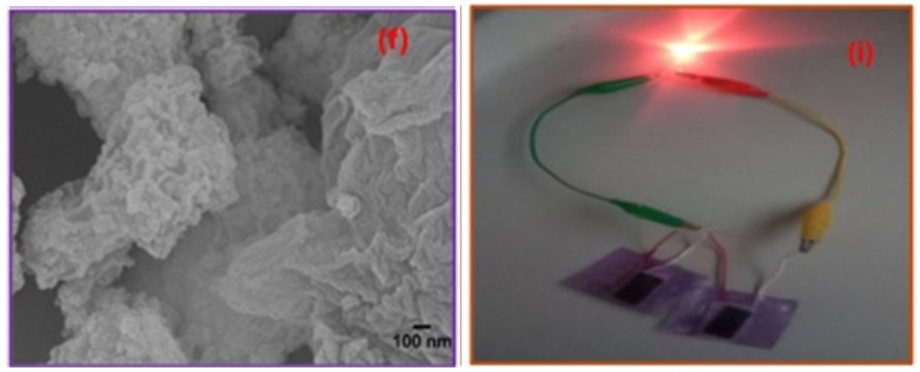
Photo description: Professor CChoi Yoon-seuk of Hanbat National University (left) and Professor Y. Mona of Chiang Mai University
Photo description: Microscopic photo of the nanostructure of the new composite electrode material developed by the joint research team (left) and the operation of an LED bulb using the pouch-type next-generation high-speed battery developed by the team (right)
- Achieved enhanced energy storage performance supercapacitors by combining ‘Flower-shaped’ nanoparticles and thin graphene
- International joint research achievement based on ‘Global PBL’ exchanges with Chiang Mai University since 2019
□ Hanbat National University announced that the research team of Professor Choi Yoon-seok from the Department of Electronics Engineering developed a fast-charging next-generation supercapacitor through international joint research with a research team from Chiang Mai University in Thailand.
○ The research results were published in March in 'Energy Nexus' (Impact Factor 9.5, JCR top 7%), a world-renowned academic journal in the energy field, under the title ‘Enhanced energy storage performance of Cu2SnS3@rGO electrode in pouch-type asymmetric supercapacitors’.
* Supercapacitor: A next-generation energy storage device that stores less energy than general batteries but has very fast charging and discharging speeds, high output, and a long lifespan.
○ To improve supercapacitor performance, attention has been paid to 'copper-tin compounds' capable of storing significant energy, but these materials have drawbacks such as volume expansion during charging and discharging, low electrical conductivity, and short lifespans.
□ To solve these problems, the research team of Professor Choi Yoon-seok and Professor Y. Mona from Chiang Mai University utilized 'graphene (reduced graphene oxide)'.
○ They developed a new composite material (Cu2SnS3@rGO) by evenly sandwiching copper-tin nanoparticles, made into a fine 'flower-shape' to increase surface area, between thin graphene sheets.
○ The graphene acted as a conductor to increase electrical conductivity and as a buffer to suppress the expansion of the copper-tin compound during charging, overcoming the limitations of existing materials.
○ The researchers manufactured a 'pouch-type' supercapacitor using this material as an electrode and confirmed advantages such as excellent energy storage capacity, power density, and long lifespan. They also demonstrated that it is ready for immediate application in actual electronic devices through LED bulb operation experiments.
□ This international joint research achievement is particularly meaningful as it is a valuable result of the ‘Global Project Based Learning (Global PBL)’ program, which Hanbat National University and Chiang Mai University have consistently maintained since 2019.
○ This program is a creative convergence curriculum where multinational students and researchers form teams to identify and solve locally applicable engineering topics, such as regional problem solving and conceptual approaches. The two universities have successfully operated the program from the 1st Global PBL in 2019 to the 5th program.
○ Through these multinational convergence programs, students and researchers from both countries have improved their international cooperation, communication, and engineering design skills. The solid foundation of exchange built over many years naturally led to this large-scale international joint research opportunity.
□ Professor Choi Yoon-seok of Hanbat National University said, “It is very meaningful that we created a high-performance new material that exceeds the limits of existing battery materials using copper and tin, which can be obtained affordably around us. Above all, the close network with overseas researchers established through Global PBL exchanges served as a strong foundation for this research, and we will continue to foster talent with global leadership and pursue convergence research.”
□ Meanwhile, the Global PBL program, which served as the basis for this achievement, was operated with support from the National University Promotion Project. The publication of this paper is evaluated as a representative achievement of the international exchange that Hanbat National University and Chiang Mai University have continued for many years.
○ Such continuous international exchange is important as it enhances students' global problem-solving and communication skills while strengthening the foundation for research cooperation among faculty, leading to follow-up achievements such as joint papers and projects. Cooperation between the two universities is expected to establish itself as an exemplary international exchange model that develops both education and research together.
- 다음글 Hanbat National University Was Chosen for the 2026 University AI Basic Curriculum Development Support Project 2026-04-24
- 이전글 Research Team Led by Prof. Park Jeong-eon of the Department of Creative Convergence Engineering Selected for Payload in Nuri's 6th Launch under the 'Space Verification Su 2026-03-11