Edu & Research
Hanbat National University Professor Kim Jung-hwan’s Team Identifies Principle of Enhancing Oxide Semiconductor Performance through Oxygen Pressure Control
작성자기획과 조회수12 등록일2026-06-15
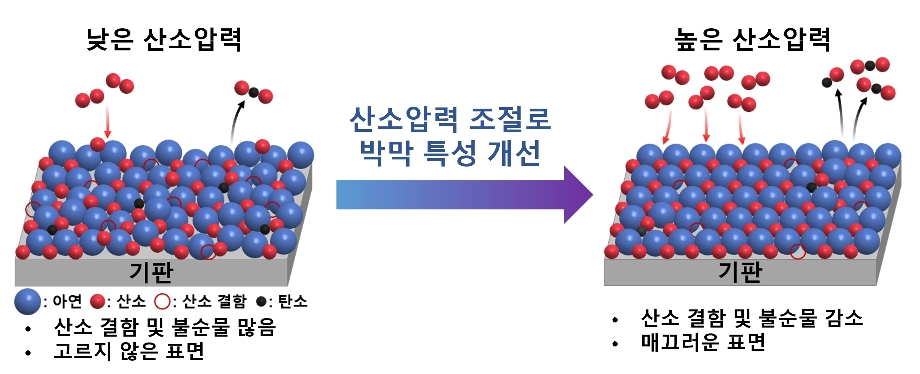
Photo caption: Hanbat National University Department of Applied Materials Engineering Master's student Ha Ji-hoon left and Department of Materials Science and Engineering Professor Kim Jung-hwan
Figure caption: Schematic diagram of research on zinc oxide ZnO semiconductor material changes according to oxygen pressure control in rapid thermal annealing by Professor Kim Jung-hwan's research team at Hanbat National University
- Reduction of defects and improvement of device characteristics in oxide semiconductors for next-generation displays and 3D memory
□ Hanbat National University (President Oh Yong-jun) announced that a research team led by Professor Kim Jung-hwan from the Department of Materials Science and Engineering(first author Ha Ji-hoon in the Master's program) identified that by precisely controlling oxygen pressure during a Rapid Thermal Annealing process defects in oxide semiconductors utilized for next generation displays and 3D memory can be effectively reduced and device performance can be enhanced.
○ This study was conducted on zinc oxide ZnO thin-film transistors which are representative oxide semiconductors and it is meaningful in that it presented a practical process optimization plan capable of enhancing the performance of oxide semiconductor devices through only oxygen pressure control in a heat treatment process without introducing new materials or complex additional processes.
□ Oxide semiconductors are drawing attention as core materials for future semiconductor technologies such as next-generation displays 3D memory and neuromorphic devices based on their excellent electrical characteristics and possibility for low-temperature processes.
○ However, because device performance varies greatly depending on the microstructure and defect state of thin films, precise defect control is essential. Previous studies have mainly focused on changes in heat treatment temperature or atmospheric gas composition leaving it insufficiently revealed that thin-film quality and device characteristics can vary depending on oxygen pressure even in the same oxygen atmosphere.
□ Accordingly, Professor Kims research team set oxygen pressure as a core process variable in the rapid thermal annealing process for zinc oxide thin-film transistors fabricated through an Atomic Layer Deposition ALD process and analyzed its effects on thin-film characteristics and device performance.
○ As a result, it confirmed that defects within the thin film can be effectively reduced and charge transport characteristics can be enhanced through only oxygen pressure control identifying the importance of oxygen pressure optimization to simultaneously achieve defect reduction and device performance enhancement.
□ Professor Kim Jung-hwan said, “This study is a result showing that semiconductor characteristics and device performance can be effectively improved through only oxygen pressure control departing from previous approaches centered on changes in heat treatment temperature or atmospheric gas composition” and added “We expect it to contribute to process optimization and productivity enhancement of various oxide semiconductor-based devices such as next-generation displays and 3D memory in the future.”
□ Meanwhile, this research result was published online on the 9th in 'Applied Surface Science' (IF 6.9 JCI Percentile 97.9%) an internationally renowned academic journal in the fields of materials science and coatings·thin films under the title of 'Oxygen-Pressure-Controlled Rapid Thermal Annealing for Defect Modulation and Performance Optimization in ALD ZnO Thin-Film Transistors’.
- 다음글 Professor Kim Min-hoe of the Department of Creative Convergence Engineering Presents Design Criteria for Polymer Tunneling Layers for Organic Memory Devices 2026-06-25
- 이전글 Professor Ha Ji-hwan's Research Team at Hanbat National University Tackles Diabetes and Diabetic Foot with Colorimetric Monitoring... Developing the World's First Wearabl 2026-05-14