Exchange & Industry
‘Korea Technology Innovation Society 2026 Fall Conference’ Successfully Concludes
작성자기획과 조회수11 등록일2026-04-27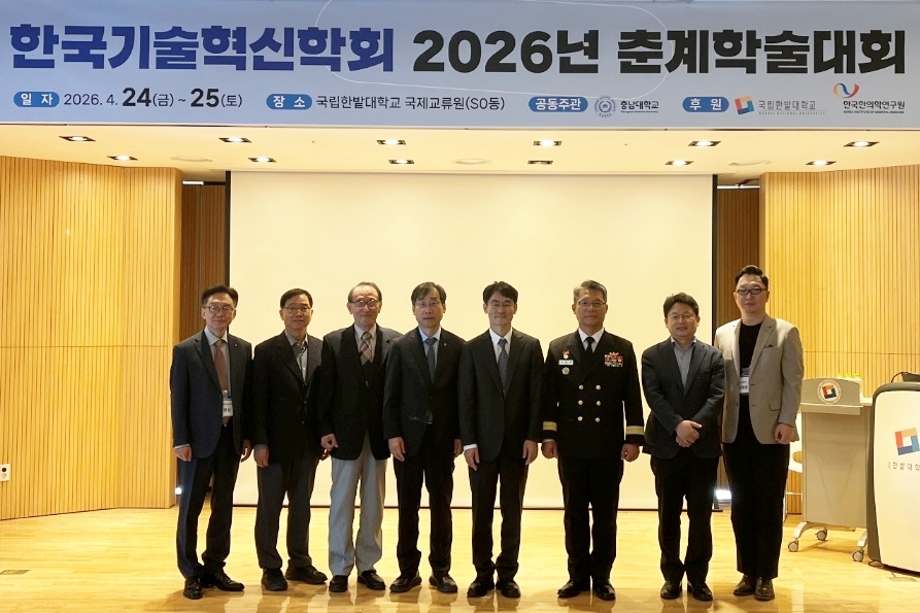
- Around 100 experts from industry‧university‧research institutes participated to share research results under the theme ‘Reflection on National Innovation System in Transition: Institutions, Actors, and Innovation Ecosystem’
□ The 'Korea Technology Innovation Society 2026 Spring Conference', hosted by the Korea Technology Innovation Society (President Kwon Ki-seok, Professor at Hanbat National University) and co-organized by the Department of Technology Commercialization and Convergence at Chungnam National University, was successfully held from the 24th to the 25th at the International Convention Center of Hanbat National University.
○ This conference was arranged under the main theme of 'Reflection on National Innovation System in Transition: Institutions, Actors, and Innovation Ecosystem' as a venue to deeply diagnose Korea's science and technology innovation system and explore future directions in an era of accelerating AI and digital transformation.
○ Sponsored by Hanbat National University and the Korea Institute of Oriental Medicine, the event was attended by around 100 major domestic and foreign dignitaries and industry-university-research experts—including Kwon Ki-seok, President of the Korea Technology Innovation Society; Oh Yong-jun, President of Hanbat National University; Brigadier General Lee Yong-tae, Director General of the Information and Communications Planning Department at Republic of Korea Navy Headquarters; Professor Ko Kil-kon of Seoul National University; and Dr. Choi Moon-hee of the Korea Social Science Data Archive at Seoul National University—to present and share the latest research results in various fields.
○ At the opening ceremony, moderated by Professor Jeong Hye-jin of Pusan National University, President Kwon Ki-seok stated, "We have set the discussion on the national innovation system, which is facing an obvious transition period—including the newly established 6th Science and Technology Basic Plan this year and major institutional changes surrounding the science and technology community recently—as the main theme of this conference".
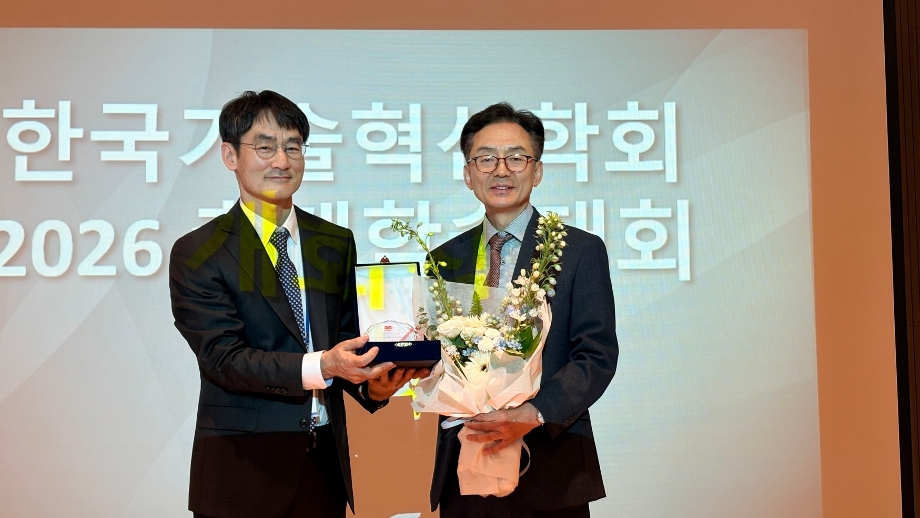
○ This was followed by a welcoming speech from Oh Yong-jun, President of Hanbat National University, and congratulatory remarks from Admiral Kim Kyung-ryul, Chief of Naval Operations (read by proxy by Brigadier General Lee Yong-tae, Director General of the Information and Communications Planning Department at ROK Navy Headquarters). A plaque of appreciation was presented to Dr. Hwang Byung-sang of the Korea Basic Science Institute, who served as the 26th president, honoring his contributions to the development of the Korea Technology Innovation Society.
□ Professor Ko Kil-kon of Seoul National University, who delivered the first keynote lecture of this conference under the theme 'Beyond the Era of AI Agents', pointed out, "As AI technology reaches a new turning point and the boundary between humans and AI agents rapidly collapses, the gap in AI utilization within organizations is becoming entrenched".
○ He also emphasized that the ability to manage organizational change in the AI era is a core competency for leaders, stating, "The concept of leadership is shifting from leading people to coordinating agents".
□ The second keynote lecture was delivered by Choi Moon-hee, Senior Researcher at the Korea Social Science Data Archive at Seoul National University, under the theme 'AI as Seen through the Eyes of a Qualitative Researcher: Technology, Ruler, Social Matrix'.
○ Researcher Choi raised fundamental questions faced by qualitative researchers amid changes in the research environment shifting from online to AI, warning of the risk that participants' contexts and interactions could be omitted during the AI utilization process, leading to biases hardening into social facts.
○ Along with a sharp reminder that "qualitative methods should not be used like a recipe," she emphasized that the reflexivity of researchers becomes even more crucial in the AI era.
□ The keynote lectures were followed by a panel discussion involving both speakers and conference attendees. First, in a discussion on the meaning of agent leadership, Professor Ko Kil-kon suggested the view that managing and supervising the AI system itself to coordinate it to move toward organizational goals is also a form of leadership.
○ Subsequently, regarding ways to enhance AI acceptance within organizations as a prerequisite for implementing agent leadership, participants shared that a lack of trust and resistance from members are major barriers to AI embedding, and agreed on the necessity of systematic change management.
□ The second major issue was professionalism and talent cultivation in the AI era. Senior Researcher Choi Moon-hee revealed that through working with AI, she discovered that a clear process beyond tacit knowledge exists in qualitative research methods as well. On the other hand, she pointed out that while AI draws macroscopically plausible conclusions, countless logical gaps are hidden behind them.
○ In addition, Professor Ko Kil-kon emphasized that according to the principle of scarcity, the value of tacit knowledge derived from deep thinking and long experience will actually increase, and that social consideration is needed for an educational environment that nurtures talent capable of thinking 'deeply, slowly, and long' in the AI era.
□ In this conference, 6 general and special sessions were arranged, including joint sessions between the Integrated Medical Science Innovation Policy Research Group and the Korea Institute of Oriental Medicine; the Department of Technology Commercialization and Convergence at Chungnam National University and Daejeon TP; and the Convergence Technology Management Policy Research Group and Hanbat National University. In each session, paper presentations and expert discussions linked to the conference theme were actively conducted.
□ Meanwhile, the Korea Technology Innovation Society, which examined the national innovation system in terms of institutions, actors, and the innovation ecosystem through this spring conference, plans to derive integrated policy directions in Jeju in December, following the summer conference in July ahead of its 30th anniversary.